



Enable INCLUSIVE GROWTH
The Bank has a policy of promoting equity, aiming to foster social equality by embracing diversity and non-discrimination both within the Bank as an organization and throughout its value chain. This approach seeks to expand opportunities for an improved quality of life and reduce inequality, thereby strengthening social foundations and contributing to sustainable growth.
The Bank is committed to conducting business sustainably, with due recognition of human rights as fundamental rights inherent to human dignity, protected by law and central to creating shared value with society. The Bank’s responsibility for human rights covers all parties involved across every dimension of its business operations, including employees, customers, counterparties, business partners, government agencies, and local communities affected by the Bank’s activities. This commitment is upheld under principles of non- discrimination, gender equality, the prohibition of child labor and forced labor, the prevention of human trafficking, freedom of association and collective bargaining, fair employment practices, and the protection of personal data, to ensure that the Bank’s business operations generate genuinely positive impacts on people and society.
The Bank’s human rights operations are grounded in internationally recognized global principles and standards, including:
Human Rights Policy, Read more.
Examples of financial products and services developed to support vulnerable groups
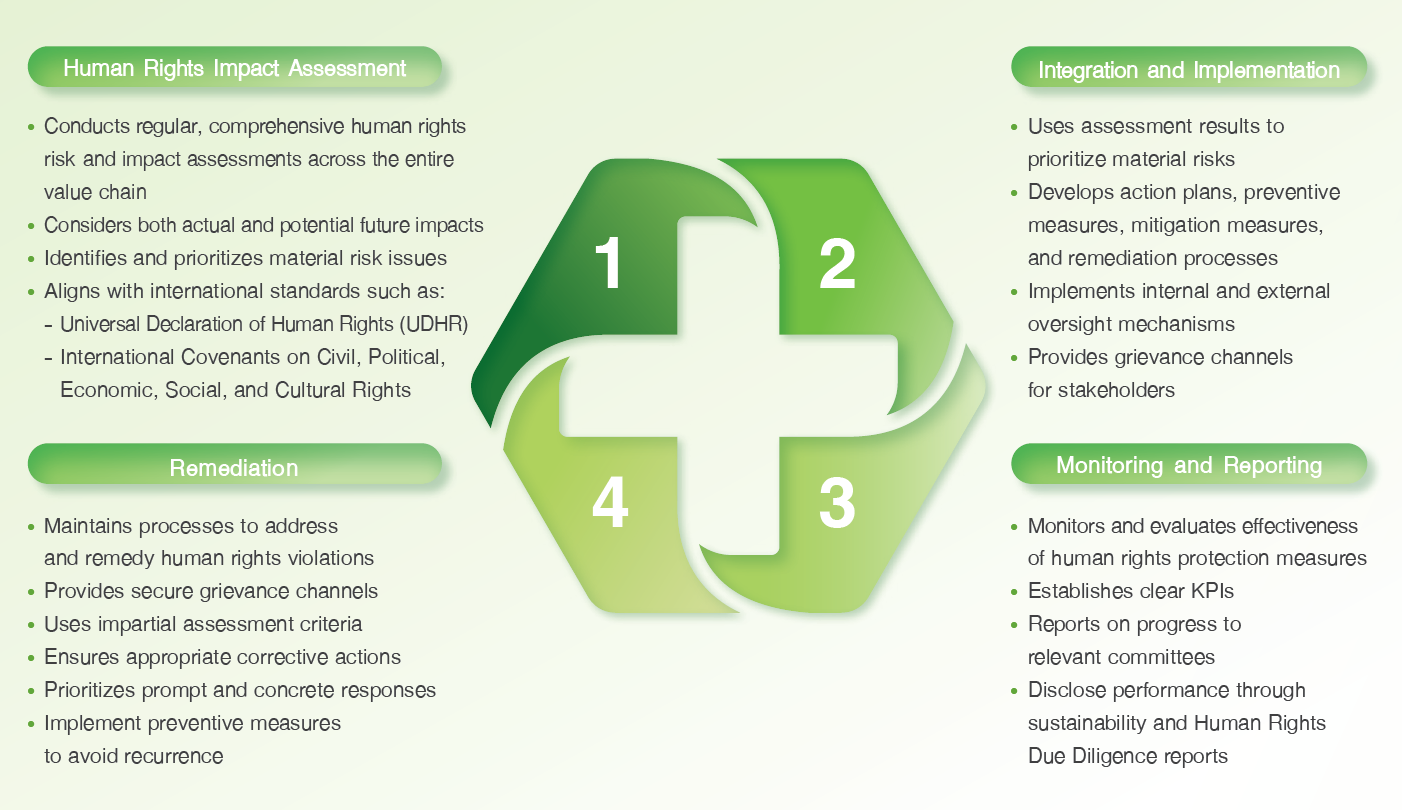
In accordance with the United Nations Guiding Principles on Business and Human Rights, the Bank conducts a comprehensive human rights due diligence every year to ensure that the Bank’s operations do not infringe upon the rights of all stakeholders throughout the business value chain.
KASIKORNBANK conducts its business under the aspiration of becoming a Bank of Sustainability, with a commitment to efficient management across all units while taking into account the governance of risks and impacts on society. This aims to strengthen the stability of the financial system, which is closely connected with the overall economic and social systems in the long term. Therefore, the Bank has shifted its approach from conceptual frameworks toward practical implementation, translating its vision into tangible actions through the formulation of strategies and operational targets to enhance competitiveness and create long-term value for both the organization and society. When society and the country become stronger, businesses will be able to operate sustainably as well. The Bank also invests in and implements social projects in alignment with international sustainability standards and the United Nations Sustainable Development Goals (SDGs). These efforts contribute to stable economic growth, strengthening social resilience, improving the quality of life of the population, and maintaining environmental balance in a sustainable manner.
The Bank has translated its sustainability strategy into practical implementation by leveraging its strengths and capabilities to create value for society through investments in social projects in various forms. These initiatives emphasize partnerships in building a sustainable ecosystem, while promoting integrated sustainable development concepts together with raising awareness and encouraging participation in activities for public benefit. Beginning with the Bank’s employees, key initiatives include the AFTERKLASS Project and the “Tham Di Tham Dai” program. Through this approach, employees play an important role in initiating and developing community projects tailored to the specific contexts and needs of each area, supported systematically by the Bank.
In its role as a responsible corporate citizen committed to building a sustainable ecosystem for the country, the Bank focuses on addressing challenges in Nan Province, which contains Class 1 watershed forests with rich biodiversity. These forests are a vital national resource and the source of the Nan River, contributing more than 40 percent of the water volume to the Chao Phraya River, a major river essential to the livelihoods of people nationwide. As a strategically important area requiring urgent environmental care and restoration, the Bank has implemented projects in Nan Province continuously, gaining a clear understanding of the local context and challenges. The Bank believes that addressing these challenges can generate positive impacts not only within Nan Province but also for other parts of the country that depend on and benefit from the Chao Phraya River. The Bank therefore carries out projects in collaboration with foundations, with the public sector, private sector, and civil society. These efforts aim to generate broad benefits while establishing a strong ecosystem foundation for economic, social, and environmental security. Addressing root causes of the problem represents a key success factor in solving upstream issues while supporting the development of Nan Province as a model city of sustainability. This approach represents a strategic ecosystem Investment that can be expanded and applied as a framework for environmental management and sustainable urban development in other areas of the country.
The Bank continuously monitors and evaluates the outcomes of its social investment initiatives, including compliance with the B4SI (Business for Societal Impact) international standard and the application of the Social Return on Investment (SROI) framework to translate social impact into measurable economic value. This ensures that the Bank’s social investments generate positive impact and create ecosystem value in alignment with strategic objectives. The Bank believes that implementing social initiatives under clear monitoring and evaluation frameworks strengthens stakeholder confidence, supports its social license to operate, enhances corporate reputation, and serves as a structural risk management mechanism that supports stable and sustainable long-term growth. Ultimately, these efforts form a critical foundation for Thailand’s holistic and sustainable development.