


Reinforce FUTURE-READY RESILIENCE
The Bank is committed to strengthening the preparedness and resilience of its risk management processes by proactively identifying, managing and responding to emerging risks and disruptions across the entire value chain of the Bank, its counterparties, and customers. In parallel, the Bank ensures that its capital adequacy is at an appropriate and sufficient level to maintain strong financial stability and support sustainable business growth.
KBank has established risk management policy, risk appetite, and risk management process in line with international practices to ensure its efficient and effective risk management system. Setting risk limits is part of the Bank’s business planning process and risk culture. The determination of the risk appetite is based on the principle of balancing expected returns against potential risks, taking into account management in accordance with the principles of a Bank of Sustainability. The Bank reviews strategic plans and conducts stress tests under different scenarios to assess the adequacy of its capital and liquidity. These assessments inform the determination of the risk appetite, leading to the setting of risk limits and metrics across various risks, both qualitative and quantitative, the development of risk mitigation strategies, and informed decisions to adjust the business strategy for optimal performance within the defined risk appetite. The risk management policy and strategy as well as risk appetite are reviewed at least once a year or upon significant changes.
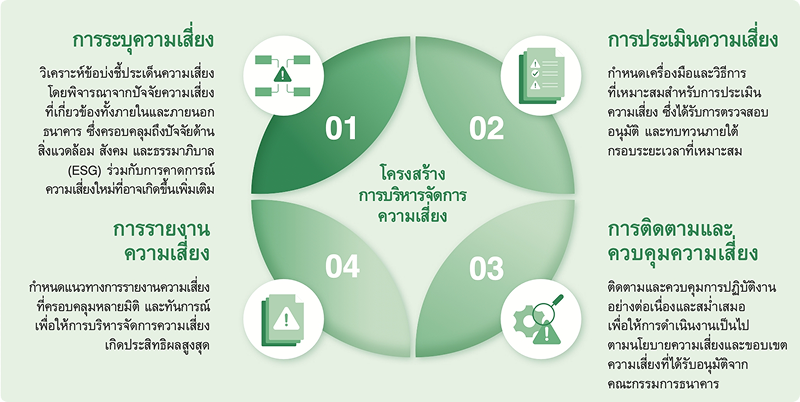
The Bank has in place a risk management process that comprises risk identification, assessment, monitoring, control, and reporting, as follows:
The Bank places importance on comprehensive risk management across all dimensions and is committed to continuously enhancing and improving its risk management practices. Key risk areas include credit risk, market risk, liquidity risk, operational risk, reputational risk, digital risk, strategic risk, and climate change risk. Further details can be found in the Bank’s 2025 Annual Registration Statement (Form 56-1 One Report), Part 1: Business Operations and Performance, under the section on Risk Management, as well as other related reports.
The Bank has established a credit management structure that takes into account a system of checks and balances across all relevant units while continuously fostering a strong work discipline and culture. This includes defining credit policies and processes, desirable and undesirable credit practices, along with communication channels. Training and regular refreshers on credit-related knowledge are regularly provided to operating officers. Additionally, the Bank has put in place monitoring processes and reporting to the credit operations review working group to consider improvements to credit policies and processes, as well as management approaches in cases of non-compliance with the prescribed criteria.
The Bank has established a credit risk management process that takes into account environmental, social and governance impacts, with particular emphasis on climate change risks. These factors are incorporated into credit underwriting and the assessment of impacts on the Bank’s credit portfolio management. In this regard, the Bank has adopted international best practices to set credit underwriting criteria covering both corporate loans and project finance, as well as investments in debt instruments by defining the (ESG Exclusion List)* and establishing Sector-Specific Guidelines*. Moreover, appropriate risk management measures are applied to high-risk business customer segments, with specialists assigned to monitor and review the management of environmental and social impacts within customers’ business operations. This ensures that the Bank’s credit risk management aligns with international standards and that the credit it supports effectively addresses environmental and social impacts. These efforts aim to support the stable growth of business customers and generate sustainable returns for all stakeholders.
The Bank regularly reviews and updates its policies and criteria for assessing ESG risks used in credit underwriting to ensure alignment with concerns towards social and environmental impacts. Additionally, ESG factors have been integrated into the Know Your Customer (KYC) and Customer Due Diligence (CDD) processes, to enhance operational effectiveness.
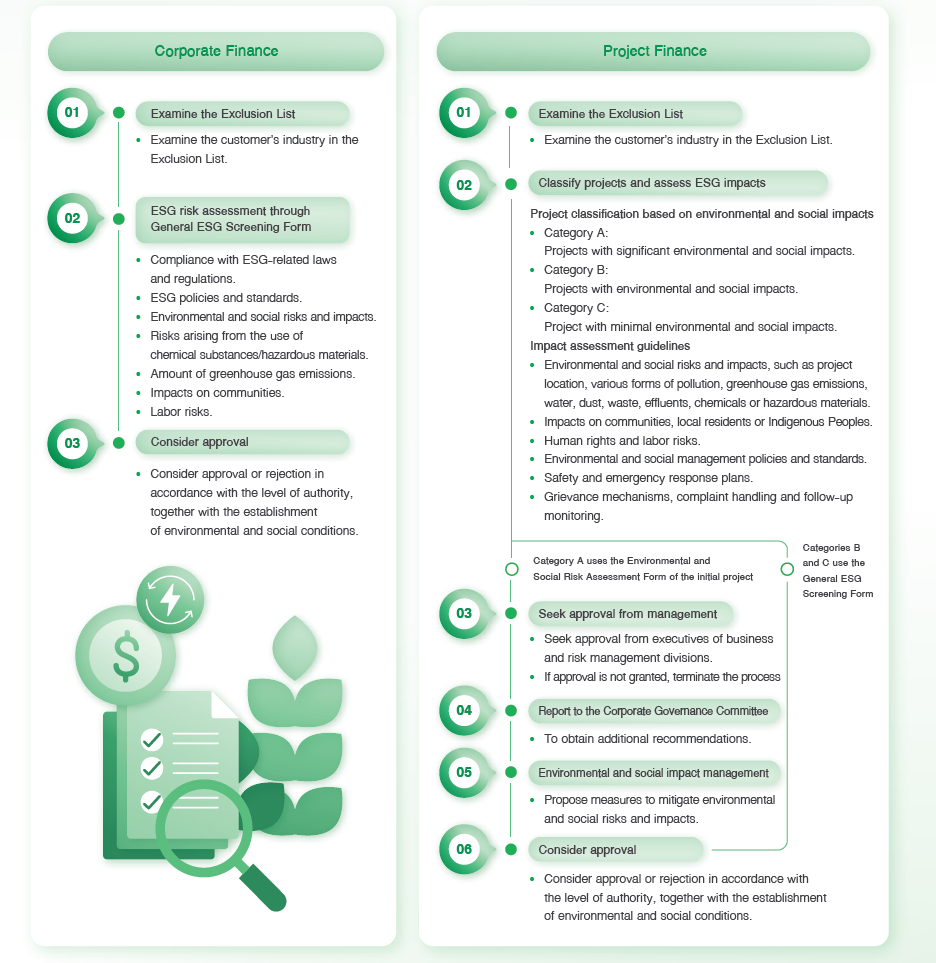
For corporate finance to medium‑sized enterprises and above, the Bank applies Environmental and Social Screening Tools through the General ESG Screening Form, which covers key ESG aspects. Project finance is subject to enhanced ESG consideration under frameworks aligned with international practices and standards to ensure appropriate identification and management of environmental and social risks.
Project Finance
The Bank integrates Environmental and Social Risk Management into its project finance credit assessment process in alignment with the Equator Principles (EP), through a structured Environmental, Social, and Governance (ESG) due diligence framework. The Bank acknowledges its responsibility to mitigate potential environmental and social impacts arising from its financing activities. All project finances are required to comply with applicable environmental laws and regulations, including Environmental Impact Assessments (EIA) and Environmental Health Impact Assessment (EHIA).
Projects are categorized into three risk levels, Project Finance Type A, B, and C, based on the scale and severity of their potential environmental and social impacts.
For Type A projects, which pose significant ESG risks, the Bank conducts enhanced due diligence that includes environmental and social impact assessment, safety and emergency response plans, action plans, community consultation, stakeholder engagement, grievance mechanisms, and information disclosure to address concerns from stakeholders including local communities, workers, and NGOs. Independent environmental and social consultants are engaged to review environmental and social information. Bank requires project finance to comply with our ESG requirements. In addition, Bank considers the environmental and social sensitivity of project locations, including those situated within legally protected areas, internationally recognized conservation zones, watersheds, and other areas of high biodiversity value, as well as sites of cultural heritage significance for local communities and Indigenous Peoples. Bank also ensures that project implementation respects the traditional way of life rights of Indigenous Peoples. Bank reviews potential impacts on community livelihoods, occupations, and resettlement, as well as the adequacy and effectiveness of proposed mitigation and remedial measures. In cases where projects affect Indigenous Peoples and displaced persons, Bank considers that a process of Free, Prior, and Informed Consultation (FPIC) is undertaken to ensure their participation and consent. For projects that may create extensive environmental and social impacts (e.g., hydropower generation from dams, projects in foreign countries, etc.), independent consultants or third-party experts are appointed to ensure that the projects are carried out in accordance with EP, the relevant regulations and laws to prevent any adverse impact on the environment and community members’ quality of life. The example list of advisors includes AFRY, WSP Global, Emergent Ventures Inter, Shaw’s Stone & Webster, and Greener Consultant etc.
For medium and lower-risk projects (Types B and C), a General ESG Screening Form is used to evaluate ESG risks and management approaches. ESG considerations are integrated into credit decisions to ensure responsible and sustainable financing.
Examples of Financial Support Considerations
*https://www.kasikornbank.com/en/ir/corporategovernance/transparency/pages/esg-credit-policy.aspx
KBank has established an Environmental and Social Management System (ESMS) as an integral part of the Bank’s sustainable finance and risk management framework. The ESMS is designed to systematically identify, assess, manage, and monitor environmental and social (E&S) risks and impacts specifically to support financing activities under the IFC Green Bond Subscription.
KBank’s ESMS is developed in alignment with international best practices based on IFC Performance Standards, and supports the Bank’s commitment to responsible banking and sustainable development.
Under the ESMS, KBank applies a structured approach to: screen and categorize projects based on their potential environmental and social risk levels, conduct appropriate environmental and social due diligence proportionate to the nature, scale, and complexity of the project, define environmental and social requirements and conditions as part of the credit approval process, and, monitor environmental and social performance.
The ESMS also incorporates governance arrangements, internal roles and responsibilities, and reporting mechanisms to ensure effective oversight and continual improvement. Through the implementation of the ESMS, KBank aims to mitigate potential adverse environmental and social impacts, promote positive sustainability outcomes, and support the transition toward a low‑carbon and climate‑resilient economy.
Read more on KBank’s Environmental and Social Management System (ESMS).